
Calvin Carter is the founder of RankCraftr, legal marketing software for law firms, and has more than a decade of experience in search marketing. His work focuses on connecting marketing performance with inquiries, consultations, and signed cases to help law firms better understand new-case acquisition. Learn more at www.rankcraftr.com.
Your Marketing Numbers Are Up, So Why Are Signed Cases Down?
Calvin Carter • September 30, 2026
Law firm owners have access to more marketing data than ever. A typical monthly report might include Google rankings, impressions, website traffic, ad clicks, phone calls, form submissions, leads, and plenty of other numbers. The problem is that more data does not always create more clarity. Traffic can be up while signed cases are down. Leads can increase while consultations decrease. Google exposure can grow without producing more business.
For a law firm owner, the real question is much simpler:
Is our marketing contributing to new cases?
One way to answer that is to follow the same path a potential client takes:
Potential Clients Reached > Website Visits > Inquiries > Consultations > Signed Cases
Instead of looking at each number separately, look at how potential clients move through that path and where new-case opportunities may be getting lost.
1. Potential Clients Reached: Are the Right People Finding the Firm?
The first number to look at is how often potential clients have an opportunity to find your firm. Depending on how your firm markets itself, that could include Google Search, Google Maps, paid advertising, legal directories, and other channels you can measure. The actual metric will be different depending on the platform. For example, Google impressions show how often your firm appeared in search results. That does not mean each impression represents a different person. So the goal is not to create a perfect count of how many individual people saw your firm. The goal is to understand whether your opportunities to be found are growing or shrinking.
Then go one step deeper. Which practice areas are gaining exposure? Which are losing it? Are you gaining ground in the geographic markets that matter to your firm? An Orange County firm could see its overall search exposure increase while losing ground for an important practice area. A San Diego firm could be getting found more often overall, but not for the types of cases it actually wants. More exposure is only valuable if it is coming from the right potential clients.
2. Website Visits: Are Potential Clients Choosing to Learn More?
Being found is the first step. The next question is whether those potential clients are choosing to learn more about your firm. This is why I would not look at an increase in website traffic and automatically call it a win. Let's say opportunities to find your firm increase 20%, but actual website visits from those channels drop 8%. Your firm is showing up more often, but fewer people are choosing to visit. That tells you something very different from simply seeing "impressions up 20%" on a marketing report.
You also want to look beyond total website traffic. Which practice-area pages gained visits? Which lost them? Are the pages connected to the types of cases your firm wants moving in the same direction as the website overall? For example, total website traffic could increase while visits to one of your most important practice-area pages decline. If you only look at the total, marketing appears to be improving. If you look at what is happening underneath that number, you might see a potential problem.
3. Inquiries: Are Website Visitors Contacting the Firm?
Next, look at whether website visitors are actually contacting the firm. Depending on your intake process, that might include phone calls, contact forms, chats, text messages, or consultation requests. There is an important distinction here:
A website visit is not an inquiry, and an inquiry is not yet a qualified potential case.
One simple number to track is:
Inquiry rate = inquiries ÷ relevant website visits
For example, let's say website visits increase 15%, but inquiries stay flat. The immediate answer may not be to spend more money getting additional people to the website. You already have more visitors. The first question should be why those additional visitors are not contacting the firm. Maybe the wrong people are reaching the website. Maybe the messaging is not connecting with them. Maybe the contact process is difficult on mobile. Maybe the pages do not give potential clients enough reason to take the next step.
The numbers will not tell you exactly which problem you have. They tell you where to start looking.
4. Consultations: Are Inquiries Becoming Real New-Case Opportunities?
This is where marketing numbers need to connect with what happens during intake. If a marketing report says leads increased from 50 to 75, that sounds good. But how many of those 75 inquiries were actually potential cases your firm wanted?
A useful number here is:
Consultation rate = qualified consultations ÷ inquiries
If inquiries increase while qualified consultations decrease, something is happening between those two stages. Maybe the marketing is attracting the wrong types of matters. Maybe the inquiries are coming from areas the firm does not serve. Maybe response times have increased. Potential clients could be dropping out before scheduling. Or there could be something in the intake process worth reviewing. This can be especially important for firms serving competitive markets such as Orange County and San Diego. Generating more inquiries does not help much if a growing percentage of them are outside the firm's service area or do not match the matters the firm handles.
This is also why I would be careful about judging marketing based only on the number of leads generated. Forty inquiries that produce 20 qualified consultations could be much more valuable than 100 inquiries that produce 5. More leads do not always mean more new-case opportunities.
5. Signed Cases: Are Consultations Becoming Clients?
The last number is the one law firm owners ultimately care about. How many qualified consultations became signed cases? To measure this, marketing data has to connect with the firm's intake records, CRM, case-management system, or whatever system the firm uses to track signed cases.
A helpful number is:
Consultation-to-client conversion rate = signed cases ÷ qualified consultations
Now let's say qualified consultations remain steady, but signed cases decline. That tells you the problem may be happening after potential clients reach the consultation stage. Instead of focusing on generating more traffic or inquiries, look at what happens during and after the consultation. Are potential clients receiving the right follow-up? Has competition changed? Are expectations or case fit becoming an issue? Has anything changed in the process between consultation and retention?
The numbers cannot tell you the exact reason. But they can tell you where to start looking and keep you from trying to solve the wrong problem. If the issue is happening after the consultation, simply generating more website traffic may not fix it.
Where Are New-Case Opportunities Being Lost?
This framework becomes much more useful when you put all five numbers together. Imagine a firm sees the following changes in one month:
| Stage | Monthly Change |
|---|---|
| Potential Clients Reached | +18% |
| Website Visits | +11% |
| Inquiries | +8% |
| Qualified Consultations | -14% |
| Signed Cases | -17% |
There are several positive numbers here. The firm is being found more often. Website visits are up. Inquiries are up. A marketing report could easily focus on those improvements. But a law firm owner should notice something more important: Inquiries increased, but qualified consultations dropped. That is where I would start looking.
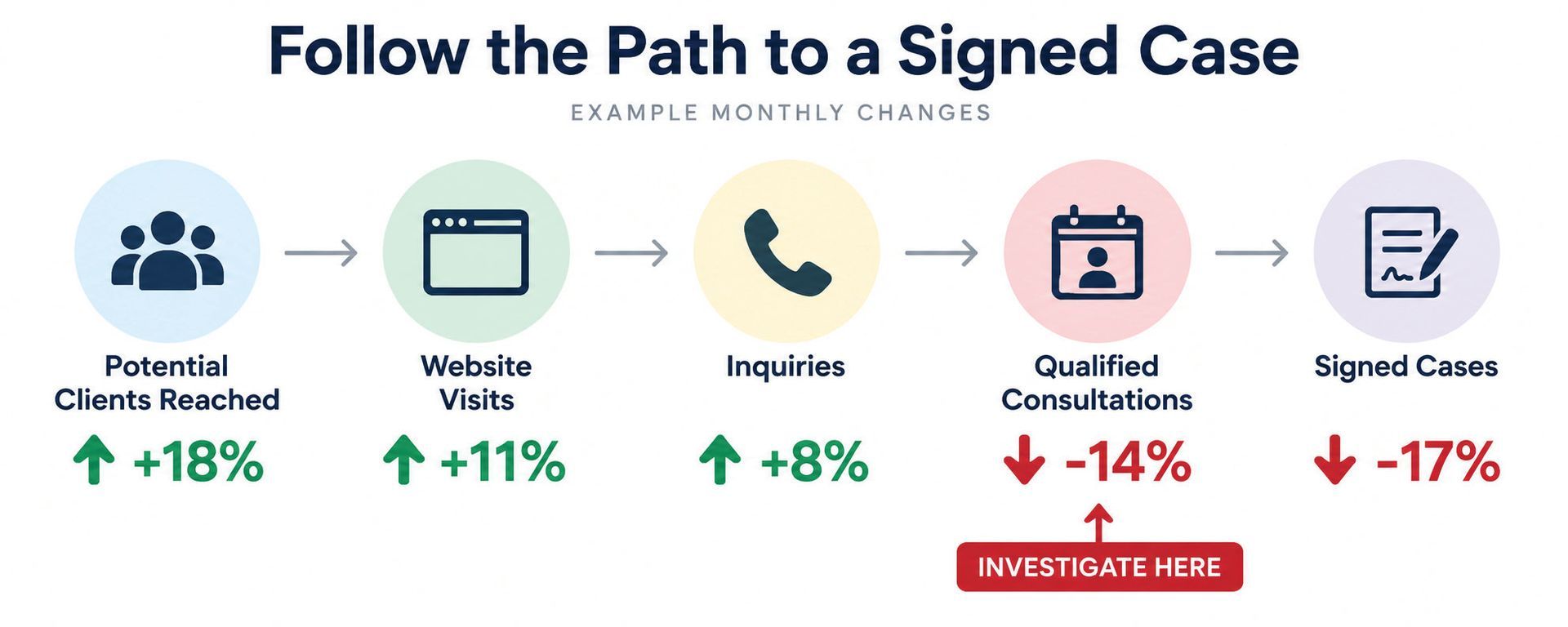
Getting more traffic could produce even more inquiries, but it would not explain why fewer of the firm's existing inquiries are turning into qualified consultations. The next step should be figuring out what changed between those two stages. Did lead quality change? Did the sources of those inquiries change? Are potential clients getting a quick response? Did anything change in how the firm handles or qualifies inquiries?
Now imagine the opposite. Consultations are turning into signed cases at a healthy rate, but fewer potential clients are finding the firm, and website visits have been declining. In that situation, the firm may be doing a good job once someone contacts it. The problem is that fewer people are reaching that point.
Both situations can end with the same result: Fewer signed cases. But they are different problems and should lead to different next steps. That is why individual marketing numbers can be misleading when they are viewed by themselves.
A Monthly Scorecard Doesn’t Need to Be Complicated
You do not need dozens of numbers to start looking at marketing this way. Each month, start with five:
| Stage | Question |
|---|---|
| Potential Clients Reached | Are the right prospective clients finding us? |
| Website Visits | Are they choosing to learn more? |
| Inquiries | Are they contacting us? |
| Consultations | Are they becoming legitimate new-case opportunities? |
| Signed Cases | Are those opportunities becoming clients? |
Compare those numbers with the previous month and the recent 90-day trend. Once you have enough historical data, comparing the same period year over year can also help account for normal seasonal changes. Then look at how the numbers move together.
If signed cases declined, work backward. Did consultations decline? Did inquiries decline before that? Did website visits fall? Are fewer potential clients finding the firm? The goal is to figure out where the path to a signed case changed so you know what deserves attention first.
Your Marketing Report Should Tell You What to Do Next
Marketing attribution will never be perfect. A potential client might hear about your firm from a friend, read your reviews, search your name on Google, visit your website, leave, and then call three days later. No marketing report is going to perfectly explain every decision that person made. It does not need to.
A useful monthly marketing review should help a law firm owner answer three questions: What changed? Where are new-case opportunities being lost? What should we investigate or improve next?
The goal is not perfect attribution. The goal is having enough information to understand what is affecting new-case acquisition and make a better decision about what to do next.

Advertisement

Advertisement

Advertisement


Contact William O. London Kimura London & White LLP 17631 Fitch Irvine, CA 92614 949-776-2874 www.klw-law.com

Contact Gomez Trial Attorneys 755 Front Street San Diego, CA 92101 TheGomezFirm.com

Contact CaseyGerry Francavilla Blatt LLP 110 Laurel Street San Diego, CA, 92101-1486 619-238-1811 www.CaseyGerry.com

Contact Rosing Pott & Strohbehn LLP 770 1st Avenue, Suite 200 San Diego, CA 92101 619-990-3158 www.rosinglaw.com