
Calvin Carter is the founder of RankCraftr, an autonomous SEO and visibility intelligence platform focused on law firms. He writes about AI search behavior, digital trust formation and how evolving online discovery patterns are changing legal client acquisition. Learn more at www.rankcraftr.com.
Why Law Firms Are Seeing Changes in New Case Flow
Calvin Carter • June 29, 2026
Why rankings and traffic alone no longer fully explain intake performance.
Many law firms still evaluate marketing performance primarily through rankings, traffic, and lead volume.
These metrics are still important, but they no longer explain the entire intake picture.
A law firm can rank well, generate traffic, and still quietly lose potential clients before a consultation request ever occurs. Most of the time, the issue is not visibility alone. It is what happens during the evaluation process between the search result and the first contact.
Potential clients now compare reviews, validate firms through branded searches, evaluate attorney credibility, and ask AI tools legal questions before deciding who to trust. Important decisions are being made before a law firm website is ever visited.
That shift is changing how firms should think about visibility, differentiation, and new case flow.
Rankings No Longer Tell the Full Story
Traditional SEO reporting still focuses heavily on rankings, impressions, clicks, and traffic.
Those metrics still matter, but they do not fully capture several factors that now influence whether visibility actually turns into consultations and retained cases. Issues like losing trust during comparison, weak differentiation, intake friction, review inconsistency, AI-assisted pre-screening, and poor Google Maps visibility can all hurt intake performance long before a consultation request ever occurs.
Visibility and consideration are no longer the same thing.
Two firms may rank similarly while producing very different intake outcomes. One firm may appear more specialized, more trustworthy, or more established during the evaluation process, even when both firms are ranking in search results.
That difference can directly impact consultation volume and retained cases.
The New Client Evaluation Process Starts Earlier
One way to understand this shift is through what can be called the “Law Firm Discovery Journey”:
Problem Happens > Search Begins > AI + Maps Results > Shortlist Formation > Trust Validation > Practice Area Comparison > Brand Search > Contact & Intake
At each stage, potential clients are making small decisions about trust, relevance, and credibility.
The process often begins immediately after a legal issue occurs. Someone involved in a car accident, employment dispute, or business conflict may begin searching online under stress and with a limited understanding of the legal process.
Historically, those searches were relatively direct:
- “San Diego employment lawyer”
- “Orange County personal injury attorney”
Now, the process often starts much earlier and more conversationally.
Potential clients can ask AI:
- “Do I even need a lawyer for wrongful termination?”
- “What is my case worth?”
- “Should I settle?”
- “How long do claims usually take?”
- “What should I do after a truck accident?”
A recent LexisNexis consumer survey found that among consumers familiar with generative AI tools, 48% had already used AI for legal advice or assistance with a legal question.
That changes how firms enter the decision-making process.
Many people now receive preliminary information before ever reaching a law firm website. Google’s AI Overviews, ChatGPT, Gemini, and other AI-assisted tools can summarize information directly within search experiences.
Research from the Pew Research Center recently found that users presented with AI-generated summaries were less likely to click traditional search results than users who did not encounter AI summaries.
In many cases, the law firm website is no longer the first impression. It is simply one checkpoint within a broader evaluation process.
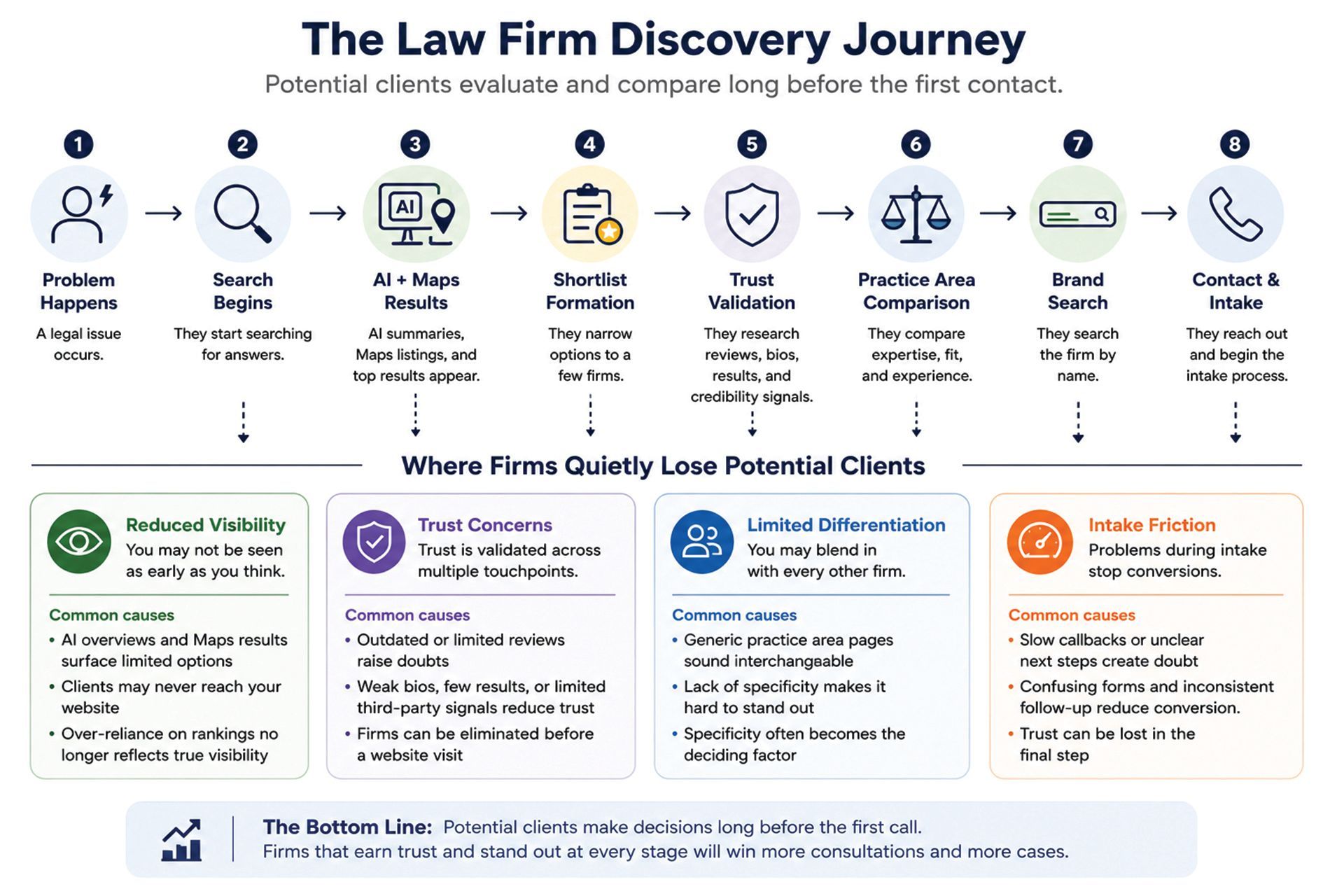
Where Firms Quietly Lose Potential Clients
Many intake problems occur before the intake team ever receives the lead. That is one of the biggest shifts many firms fail to measure properly.
Reduced Visibility
AI-generated summaries and Maps results are changing how users interact with search results. Potential clients may narrow options before clicking through to websites at all.
In some cases, potential clients place more weight on branded searches, Google Maps visibility, review platforms, and third-party credibility signals than traditional rankings alone.
Trust Concerns
Potential clients now validate firms across multiple touchpoints before making contact. They may compare Google reviews, attorney bios, verdicts and settlements, directory profiles, media mentions, and AI-generated summaries before deciding who to trust.
Someone comparing multiple firms may quickly eliminate a firm that appears outdated, inactive, or less established online, even if that firm ranks well organically.
Limited Differentiation
Many practice area pages still sound interchangeable.
Potential clients look for signals that a firm specifically handles situations similar to their own. A person researching a trucking accident case may look for references to catastrophic injuries, commercial vehicle litigation, or trial experience instead of broad personal injury language.
Specificity often becomes the deciding factor during the comparison stage.
Intake Friction
Even after a potential client decides to contact a firm, intake problems can still interrupt conversion.
Slow callbacks, unclear next steps, confusing forms, and inconsistent follow-up can all reduce conversion during intake. A firm may successfully build trust throughout the discovery process only to lose that trust during the final stage.
What Law Firms Should Actually Monitor
As search behavior evolves, firms may need to pay closer attention to signals beyond rankings alone, including:
- Google Maps visibility
- Review recency and consistency
- Intake response speed
- Branded search activity
- Practice area specificity
- AI-generated summaries
- Comparison-stage trust signals
- Consultation-to-retainer conversion trends
This is no longer just about SEO in the traditional sense.
It is about how trust forms before a consultation request ever occurs.
Potential clients now evaluate firms across multiple touchpoints before deciding who to contact. Firms that appear more trustworthy and differentiated during those early stages may outperform firms with similar rankings but weaker comparison-stage signals.
Conclusion
Search visibility still matters, but the relationship between visibility and retained cases is becoming more layered than it once was.
Potential clients now ask AI tools questions before contacting attorneys. They compare firms through Maps listings, reviews, AI-generated summaries, and branded searches before deciding who to trust. In many cases, important decisions are being made before a website visit or consultation request ever occurs.
Firms that continue evaluating marketing performance primarily through rankings and traffic may miss important changes happening earlier in the client decision-making process.
The firms that adapt fastest may not simply be the firms that rank highest, but the firms that build the most trust throughout the entire discovery journey.

Advertisement

Advertisement

Advertisement


Contact Gomez Trial Attorneys 755 Front Street San Diego, CA 92101 TheGomezFirm.com

Contact CaseyGerry Francavilla Blatt LLP 110 Laurel Street San Diego, CA, 92101-1486 619-238-1811 www.CaseyGerry.com

Contact Rosing Pott & Strohbehn LLP 770 1st Avenue, Suite 200 San Diego, CA 92101 619-990-3158 www.rosinglaw.com

Contact Erik Friis Superior Law Center 2667 Camino del Rio South, Suite 304-1 San Diego, CA 92108 619-743-9130 www.superiorlawcenter.com