

Attorney Journals is a Southern California B2B trade publication for and about private practice attorneys. The magazine brings information and news to the legal community as well as providing a platform to spotlight the people, events and happenings of the industry. But that's not all. From marketing advice to business and personal development tips, we're the top resource you need to thrive in the ever-evolving and highly competitive legal industry.

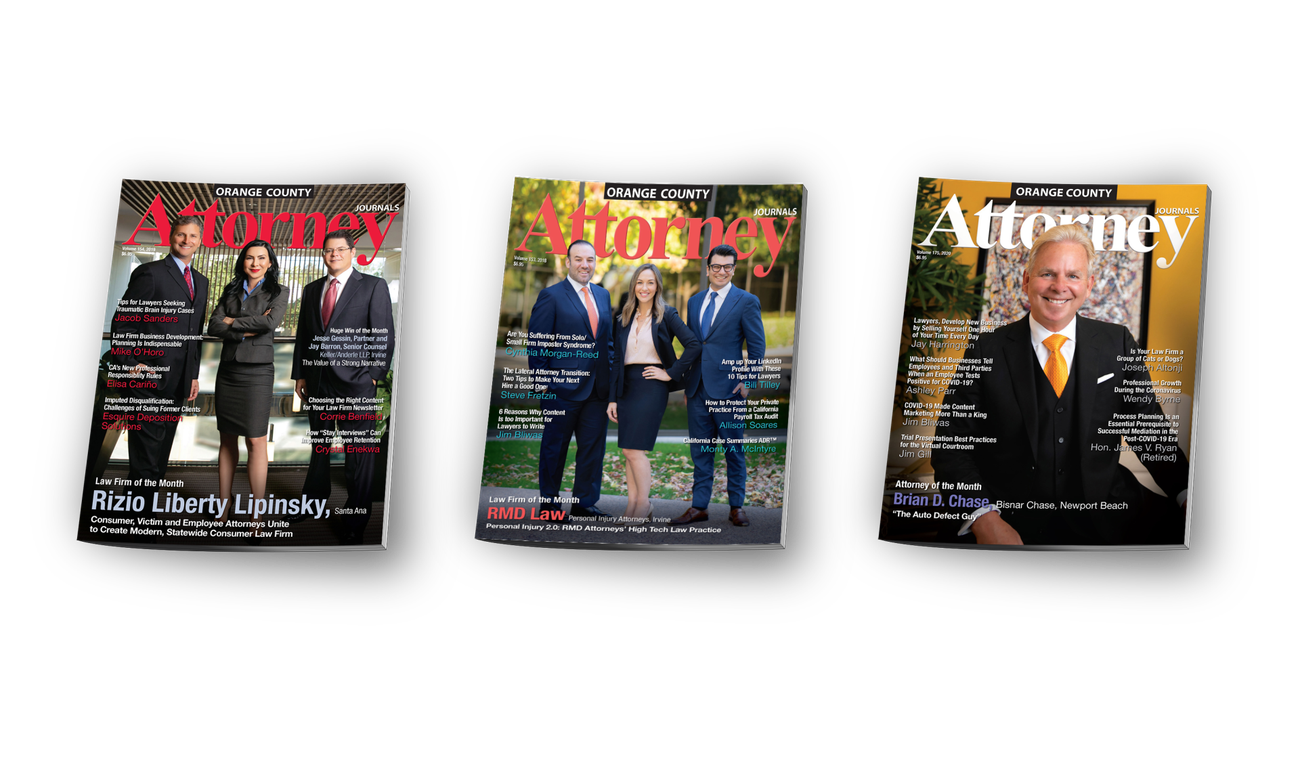
The Latest Stories, Tips and Buzz!
William O. London
Kimura London & White LLP
Succeeding at the Intersection of Business, Law and Culture

Advertisement




Before visitors read the first word on your website, an impression is being made. The copy may be great, but appearance matters. The visuals on your firm’s website can dramatically influence audience perception of personality, professionalism, trustworthiness, competence, and credibility almost instantly. In many instances, visitors are looking for a reason to qualify—or disqualify—a firm as quickly as possible when reviewing your website. Similar to a candidate going to a job interview, you want to make a first impression that presents you in the most favorable light. Give your firm an advantage by providing a visual experience that combines the power of words and imagery to make a positive impact. The First 5 Seconds In the first 5 seconds, visitors are looking for reasons to give you the next 30, then 60, and so on. While your firm may be spending hours debating specific wording in an attorney bio or practice area description, neglecting imagery can place you at a serious disadvantage. Great copy alone is not enough to overcome a poor visual impression. Building interest and trust is a cumulative process driven by both words and images. Choosing the Right Imagery Imagery deserves strategic attention. Visuals should work as hard as the copy. Choose visuals that are not simply decoration, but support or help communicate your messaging. Legal matters often include an emotional component. Words can describe how your firm understands the challenges clients face, but imagery can drive the point home. Making a human connection matters more than ever. Especially online. Authenticity Matters Stock photography is now inexpensive and widely available, making careful selection essential. Generic, overused images can make a firm look interchangeable with many others, weakening differentiation and potentially creating skepticism. Avoid visual clichés such as: Handshakes Courthouse columns Scales of justice Smiling models pretending to be attorneys (and don’t forget that using actors without a disclaimer is a breach of professional conduct rules in some states). In a profession built on trust, why choose imagery that immediately feels artificial? People Hire Lawyers, Not Buildings Many firms showcase offices, conference rooms, skylines, and architecture while providing very little insight into the people behind the firm. Clients are ultimately choosing individuals and relationships. What Does Your Photography Say About Your Firm? The style of photography throughout your website should be consistent and reflect quality. There should never be photos with poor lighting, bad angles, or low resolution. It shows a lack of attention to detail—not something you’d want associated with your firm. Most law firms would never allow an inaccurate attorney bio or poorly written homepage headline to remain on their website. Yet many leave outdated, generic, inconsistent, or strategically weak imagery untouched for years. Avoid outdated or amateurish headshots. Instead, use professional photographs that make attorneys appear approachable, confident, and experienced. The Rise of AI Imagery In a profession where authenticity and credibility are paramount, what are the risks of using AI imagery instead of investing in real photography? While there are many examples of extremely realistic AI images, an important question to ask is whether or not visitors can recognize that an image was generated using AI. Does it increase efficiency at the expense of trust? Is it worth the risk when there are many sources of affordable and authentic images to choose from? Again, authenticity matters. Technically Speaking—The Hidden SEO and Performance Impact Even with the right imagery, it is important to connect visual strategy with website performance and SEO. Oversized or poorly optimized images can slow down a site, especially on mobile, creating a frustrating experience for visitors and potentially affecting search visibility. Images can also help search engines better understand a page. Descriptive file names, useful alt text, and placing images near relevant content all provide helpful context. For example, jane-smith-employment-law-attorney.jpg is far more meaningful than IMG_4827.jpg. Alt text should first and foremost describe the image clearly for people using screen readers, while also giving search engines useful information about what the image represents. The goal is not to obsess over technical details. It is to make sure your images look good, load quickly, support content, and are easy for both visitors and search engines to understand. Image optimization may happen behind the scenes, but its impact on user experience, accessibility, and SEO is very real. The Big Picture Your website should make people feel confident about your firm before they ever pick up the phone. That means the images need to do more than look polished. They should help visitors understand who you are, what it feels like to work with you, and why your firm is the right choice. At LISI, we choose imagery with that bigger picture in mind. We think about how each visual supports your message, reflects your brand, builds trust, and guides visitors toward taking the next step. If your website looks generic, dated, or disconnected from the firm you are today, it may be costing you opportunities. A thoughtful website can help turn more of the right visitors into conversations.

When a law firm has an important position to fill, the interview process should move in an organized sequence. The firm should review the applications, select a group for first-round interviews, interview those candidates on the same day, identify the finalists, complete appropriate reference and background checks, and then conduct the final interviews on another designated day. Many law firms do not follow this process. Instead, they fall into what might be called the “trickle interview process.” One candidate interviews on Monday. Another comes in on Wednesday. Two more are interviewed the following week. A promising applicant cannot meet for another ten days, so the firm waits. Meanwhile, another resume comes in that somebody wants to consider. Before long, the interview process has stretched across several weeks. Some of the strongest candidates have accepted other jobs. The interviewers can no longer remember how the early candidates performed. The open position remains unfilled, and the hiring process seems to have no end. This is the trickle interview process. It is an inefficient way for law firms to hire. What Causes the Trickle Interview Process? The trickle approach usually begins when a law firm schedules interviews entirely around each candidate’s availability. Instead of establishing one or two dates for first-round interviews, the firm asks each candidate, “When are you available?” Every applicant provides different dates and times. The firm then tries to accommodate all of them. Being considerate of candidates is important. However, the law firm must still control its hiring process. A firm cannot allow every candidate’s calendar to determine when the firm will make an important hire. If it does, the interviews will inevitably spread across many days or weeks. The problem can become worse when several managers or lawyers must participate. Every candidate’s schedule must then be coordinated with the calendars of multiple interviewers who also have hearings, client meetings, deadlines, and other responsibilities. What looked like flexibility quickly turns into disorder. The Law Firm Begins Losing Good Candidates Strong candidates are rarely applying to only one employer. They may be interviewing with several law firms, companies, government agencies, or other organizations simultaneously. While one law firm is slowly conducting first-round interviews, another employer may have already completed two rounds and extended an offer. The candidate who interviewed first in the trickle process may wait two or three weeks without receiving a decision. Eventually, that person may assume the firm is not interested or that its management is indecisive. By the time the firm finally identifies its preferred candidate, that individual may have accepted another job. The law firm then moves to its second choice. But the second choice may also be gone. The firm may have to settle for a weaker candidate or restart the entire process. Moving slowly does not necessarily produce a more careful hiring decision. It may simply ensure that the best candidates are no longer available when the firm is ready to decide. Interviewers Cannot Compare Candidates Effectively Another significant problem is the inability to compare candidates accurately. When six candidates interview on the same day, their qualifications, personalities, communication skills, and answers are fresh in the interviewers’ minds. The hiring team can compare the candidates while the information is current. That becomes much harder when the interviews occur over several weeks. The interviewers may remember the most recent candidate more clearly than the person who interviewed two weeks earlier. They may forget an excellent answer provided during an early interview. They may also remember a general impression without recalling the facts supporting it. Interview questions may change as well. One candidate may be asked difficult follow-up questions while another receives a much easier conversation. One interviewer may focus on experience, while another focuses primarily on personality. The U.S. Office of Personnel Management’s guidance on structured interviews explains that candidates should generally be asked the same predetermined questions and evaluated under consistent standards. Conducting interviews in an organized block makes that consistency much easier to maintain. The trickle process makes comparisons less reliable and allows recency, memory, and inconsistent questioning to influence the final decision. The Hiring Standards Begin to Drift When the process lasts too long, the standards for the position may also begin to change. At the beginning, the firm may have a clear understanding of the experience, compensation range, availability, and skills it wants. As weeks pass, managers may become frustrated with the vacancy and start relaxing those expectations. A candidate who would not have advanced during the first week may suddenly appear acceptable during the fourth week because the firm is tired of interviewing. The opposite can also occur. The firm may continue waiting for a perfect candidate who does not exist. Every time the firm nears a decision, somebody wants to interview one more applicant. There must eventually be a cutoff. Otherwise, the firm never compares a defined group and never makes a decision. The Open Position Continues Harming the Firm An unfilled position is not merely an administrative inconvenience. When a law firm is short an attorney, paralegal, legal assistant, finance employee, receptionist, or manager, somebody else must perform that work. Existing employees may have to carry additional files, answer more calls, complete extra administrative tasks, or work longer hours. That can lead to: Reduced productivity Lower billable hours Slower client communication Delayed projects Employee frustration Burnout Overtime expense Client dissatisfaction The longer the trickle interview process continues, the longer the law firm operates without the employee it has already determined it needs. Interviewing one person at a time can feel less disruptive in the moment. In reality, it extends the disruption over many weeks. For practicing lawyers, scattered interviews can be especially distracting. Instead of setting aside one day for interviews and returning to their cases, they repeatedly interrupt their legal work for isolated interviews. The Firm Can Appear Indecisive Candidates are evaluating the law firm too. A hiring process that lacks a defined schedule may cause applicants to question how the organization is managed. Long periods without communication, repeatedly rescheduled interviews, and uncertainty about the next step can make the firm appear disorganized. A candidate may reasonably wonder: Does this firm make decisions promptly? Does management communicate internally? Does the firm respect deadlines? Will employment decisions also take weeks? Is the position genuinely open? Does the firm know what it wants? An organized process sends the opposite message. It demonstrates that the law firm has procedures, respects candidates’ time, and can make decisions. Follow the Proper Order of Making a Hire The solution is not to eliminate careful screening. The solution is to perform the screening in an organized order. As explained in “The law firm hiring process,” a firm should ordinarily proceed through a defined sequence: Post the open position Review and categorize the resumes Conduct first-round interviews Check references and perform any appropriate background checks with the necessary authorization Select the finalists Conduct second-round interviews Deliberate and select the preferred candidate Extend an offer while keeping an alternate in mind Notify the unsuccessful candidates after the position is filled Law firms often understand this sequence conceptually. The problem is that they do not execute it promptly. The first round should not remain open indefinitely. The firm should select a date, schedule the qualified candidates in consecutive time blocks, and complete the round. The same approach should be used for the finalists. As discussed in “Interview for open positions on the same day,” conducting each interview round on a designated day allows candidates to be compared while the discussions are still fresh. A Practical Interview Schedule A law firm might structure the process as follows: Before the First Round Establish the requirements and approved compensation range Require candidates to complete an employment application Address major salary discrepancies before scheduling interviews Review the resumes and applications Select the first-round candidates Prepare consistent, job-related interview questions Reserve one interview day on the necessary calendars Compensation expectations should be addressed early. As explained in “When a candidate’s salary expectations exceed the position’s range,” there is little benefit in repeatedly interviewing somebody who wants materially more than the firm is prepared to pay. First-Round Interview Day Schedule the selected candidates thirty minutes or an hour apart, depending on the position. Ask substantially the same core questions and use a consistent evaluation form. Each interviewer should record their impressions immediately after each meeting. At the end of the day, the firm should identify the candidates who remain in contention. Between Rounds Complete reference checks and any legally appropriate background-screening steps. Review writing samples, employment applications, compensation expectations, and other required materials. The firm should then select two or three finalists. Final-Round Interview Day Schedule the finalists on the same day. Afterward, the decision-makers should deliberate while all the interviews are fresh in their minds. The final round should not become a coronation. The firm should have multiple qualified candidates so it can make a genuine choice and retain an alternate if the first choice declines the offer. Offer Phase Once the decision is made, the firm should act promptly. A qualified candidate should not have to wait another week while managers revisit issues that should already have been resolved. Give Candidates a Reasonable Window, Not Unlimited Control There may be circumstances in which a strong candidate cannot attend on the designated day. Law firms can exercise reasonable judgment. A short video interview or a nearby alternative time may preserve the process without causing a substantial delay. However, one candidate should not be allowed to hold up the entire hiring cycle. The firm can offer a small number of interview times and explain that it is completing the round within a defined period. Candidates who are sincerely interested will often find a way to participate. The firm should be professional and courteous, but it must remain the organizer of its own hiring process. Stop the Trickle The trickle interview process may appear flexible, but it creates substantial problems. Candidates receive interviews one at a time. Decisions are repeatedly postponed. Interviewers forget the earlier meetings. Strong applicants accept other offers. The open position remains vacant. Law firms should interview by rounds, not by trickle. Conduct the first round within a defined window—preferably on one day. Conduct the final round the same way. Use consistent questions, compare the candidates promptly, and make a decision. A law firm cannot fill an important position efficiently when it allows the interview process to drift for weeks.

Law firm owners have access to more marketing data than ever. A typical monthly report might include Google rankings, impressions, website traffic, ad clicks, phone calls, form submissions, leads, and plenty of other numbers. The problem is that more data does not always create more clarity. Traffic can be up while signed cases are down. Leads can increase while consultations decrease. Google exposure can grow without producing more business. For a law firm owner, the real question is much simpler: Is our marketing contributing to new cases? One way to answer that is to follow the same path a potential client takes: Potential Clients Reached > Website Visits > Inquiries > Consultations > Signed Cases Instead of looking at each number separately, look at how potential clients move through that path and where new-case opportunities may be getting lost. 1. Potential Clients Reached: Are the Right People Finding the Firm? The first number to look at is how often potential clients have an opportunity to find your firm. Depending on how your firm markets itself, that could include Google Search, Google Maps, paid advertising, legal directories, and other channels you can measure. The actual metric will be different depending on the platform. For example, Google impressions show how often your firm appeared in search results. That does not mean each impression represents a different person. So the goal is not to create a perfect count of how many individual people saw your firm. The goal is to understand whether your opportunities to be found are growing or shrinking. Then go one step deeper. Which practice areas are gaining exposure? Which are losing it? Are you gaining ground in the geographic markets that matter to your firm? An Orange County firm could see its overall search exposure increase while losing ground for an important practice area. A San Diego firm could be getting found more often overall, but not for the types of cases it actually wants. More exposure is only valuable if it is coming from the right potential clients. 2. Website Visits: Are Potential Clients Choosing to Learn More? Being found is the first step. The next question is whether those potential clients are choosing to learn more about your firm. This is why I would not look at an increase in website traffic and automatically call it a win. Let's say opportunities to find your firm increase 20%, but actual website visits from those channels drop 8%. Your firm is showing up more often, but fewer people are choosing to visit. That tells you something very different from simply seeing "impressions up 20%" on a marketing report. You also want to look beyond total website traffic. Which practice-area pages gained visits? Which lost them? Are the pages connected to the types of cases your firm wants moving in the same direction as the website overall? For example, total website traffic could increase while visits to one of your most important practice-area pages decline. If you only look at the total, marketing appears to be improving. If you look at what is happening underneath that number, you might see a potential problem. 3. Inquiries: Are Website Visitors Contacting the Firm? Next, look at whether website visitors are actually contacting the firm. Depending on your intake process, that might include phone calls, contact forms, chats, text messages, or consultation requests. There is an important distinction here: A website visit is not an inquiry, and an inquiry is not yet a qualified potential case. One simple number to track is: Inquiry rate = inquiries ÷ relevant website visits For example, let's say website visits increase 15%, but inquiries stay flat. The immediate answer may not be to spend more money getting additional people to the website. You already have more visitors. The first question should be why those additional visitors are not contacting the firm. Maybe the wrong people are reaching the website. Maybe the messaging is not connecting with them. Maybe the contact process is difficult on mobile. Maybe the pages do not give potential clients enough reason to take the next step. The numbers will not tell you exactly which problem you have. They tell you where to start looking. 4. Consultations: Are Inquiries Becoming Real New-Case Opportunities? This is where marketing numbers need to connect with what happens during intake. If a marketing report says leads increased from 50 to 75, that sounds good. But how many of those 75 inquiries were actually potential cases your firm wanted? A useful number here is: Consultation rate = qualified consultations ÷ inquiries If inquiries increase while qualified consultations decrease, something is happening between those two stages. Maybe the marketing is attracting the wrong types of matters. Maybe the inquiries are coming from areas the firm does not serve. Maybe response times have increased. Potential clients could be dropping out before scheduling. Or there could be something in the intake process worth reviewing. This can be especially important for firms serving competitive markets such as Orange County and San Diego. Generating more inquiries does not help much if a growing percentage of them are outside the firm's service area or do not match the matters the firm handles. This is also why I would be careful about judging marketing based only on the number of leads generated. Forty inquiries that produce 20 qualified consultations could be much more valuable than 100 inquiries that produce 5. More leads do not always mean more new-case opportunities. 5. Signed Cases: Are Consultations Becoming Clients? The last number is the one law firm owners ultimately care about. How many qualified consultations became signed cases? To measure this, marketing data has to connect with the firm's intake records, CRM, case-management system, or whatever system the firm uses to track signed cases. A helpful number is: Consultation-to-client conversion rate = signed cases ÷ qualified consultations Now let's say qualified consultations remain steady, but signed cases decline. That tells you the problem may be happening after potential clients reach the consultation stage. Instead of focusing on generating more traffic or inquiries, look at what happens during and after the consultation. Are potential clients receiving the right follow-up? Has competition changed? Are expectations or case fit becoming an issue? Has anything changed in the process between consultation and retention? The numbers cannot tell you the exact reason. But they can tell you where to start looking and keep you from trying to solve the wrong problem. If the issue is happening after the consultation, simply generating more website traffic may not fix it. Where Are New-Case Opportunities Being Lost? This framework becomes much more useful when you put all five numbers together. Imagine a firm sees the following changes in one month:

Your firm may already have the information it needs to strengthen client relationships and uncover new opportunities. A relationship partner knows a client is considering an acquisition. An associate knows the client’s legal team is stretched thin. A paralegal hears that the company is expanding into a new market. Marketing learns through feedback from a webinar that the general counsel is paying attention to AI. None of these pieces of information may seem particularly significant on their own. But what if the firm could connect them? Law firms gather an incredible amount of information about their clients every day. It comes from partners, associates, paralegals, legal assistants, client teams, marketing and business development professionals, client feedback programs, pitches, RFPs, and countless informal conversations. The challenge isn’t necessarily collecting more information. It’s connecting what people already know and turning it into action. Client Feedback Is Only One Piece of the Puzzle Formal client feedback interviews are incredibly valuable. They give firms an opportunity to hear directly from clients about what’s working, what isn’t and what matters most to them. But some of the most valuable client intelligence doesn’t look like “feedback” when it happens. Once when I was involved in a client conversation, the client raved about how much she loved working with the firm and complimented the outside attorneys on how seamlessly they collaborated with her internal team. It was everything the firm was hoping to hear. Then, as the interview began to wind down, she mentioned, almost in passing, that her finance team had recently implemented a new threshold rule for approving vendor invoices. Any invoice over that threshold triggered another layer of administrative back-and-forth that she had to deal with, and it had become a huge headache. We could have simply acknowledged it with an “Oh wow, that sounds frustrating and especially during busy season!” But instead, we got curious. Could she share the threshold amount? When the firm knew the invoice was going to be over that threshold, if they broke the amount up over multiple invoices, would that help eliminate extra steps for her? Her answer was an enthusiastic (and almost relieved) yes! We immediately shared what we had learned with the relationship partner and the firm’s accounting department, and the change was quickly implemented. It was a relatively small administrative change, but it sent a big message: We heard you. We understood the problem. And we did something about it to make your life a little easier. That builds trust and strengthens the relationship. And the same principle applies to the informal conversations happening every day. Listen to Learn, Not Just to Respond Attorneys are trained to solve problems. When a client raises an issue, the instinct can be to immediately offer a solution—or start thinking about what other services the firm could provide. Sometimes, the better approach is to listen. Give yourself time to understand what the client is actually telling you. One simple follow-up can help: “This is what I heard. Is that about right?” When the conversation allows, have a few questions ready that encourage the client to share what’s really going on: What’s getting the most attention internally right now? Are there any changes happening for you or your team? Have priorities from leadership shifted? What’s coming up that you’re starting to think about? The goal isn’t to interrogate a client looking for a cross-selling opportunity. It’s to understand what matters to them and the challenges they’re facing. Sometimes that information is professional. Sometimes it’s personal. One time in a coaching session, I had a partner casually mention that client A was a diehard Buffalo Bills fan. He also knew client B was equally passionate about the team, and both would be at the game that weekend. The partner had a great relationship with both and had frequently talked football. I suggested he introduce them. His email was simple and personable: He knew they both loved the Bills, knew they would both be at the game and thought they might enjoy connecting. Their response was appreciative, and it started a dialogue between them that was all business ... the business of football. Nothing was sold. No business-development pitch was made. He connected two people based on something he had learned about them. That’s genuine relationship building. It also illustrates why listening matters. Clients want to know that their attorneys listen to more than just the legal issues. Connect the Dots Knowing something about a client is only the first step. The real value comes from connecting that information with what others in the firm know—and then deciding what to do with it. One of the biggest challenges I’ve seen is that valuable client intelligence often gets trapped with individuals. The relationship partner knows something. An associate knows something else. An assistant hears a passing comment. Marketing learns something at an event. Another practice group has a relationship with a different executive at the same company. Everyone may have a piece of the puzzle, but no one has the full picture. This is where your firm’s marketing and business development (MBD) team can be your biggest ally. MBD professionals are often the unsung heroes of a firm. They may not be the ones sitting across the table from the client, but they are frequently the people connecting the dots across relationships, practices and opportunities. They see what is happening across the firm and can help attorneys turn good intentions into a coordinated plan. The opportunity is to make sure they’re part of the conversation. For example, I’ve worked with client teams (made up of partners, associates, paralegals, and business professionals) that held monthly or quarterly meetings where everyone shared: Recent client interactions and BD activity Key developments or news Feedback they had received New contacts or relationships Potential opportunities or concerns Ways other attorneys or practice groups could help By being part of the conversation, the MBD team could then take those individual updates and turn them into something useful: What are we hearing? What patterns are emerging? Who else needs to know? And what should we do next? During one meeting, the team learned that the client had recently experienced significant turnover among its junior associates and was having a hard time getting its new hires up to speed. The group discussed how the firm could help and decided to offer a series of complimentary training sessions focused on key issues, processes and players. The client loved the idea, the sessions were a hit, and the relationship grew. That same collaboration can change how attorneys approach business development as well. I’ve often seen multiple attorneys independently identify the same client or prospect as a relationship they want to develop. Once everyone knows what everyone else is working toward, those individual efforts can become collaborative ones. And that’s where your MBD team can really shine. They can help identify the overlap, bring the right people together, develop the plan, provide the resources and—perhaps most importantly—help keep the momentum going. Attorneys bring relationships and client knowledge. The MBD team can help connect it, organize it and turn it into action. One relationship. Multiple attorneys. One coordinated approach. That’s the power of connecting the dots. Don’t Overlook the Intelligence in RFPs and Pitches RFPs and pitches are another often-overlooked source of client intelligence. Yes, the firm needs to answer the questions. But pay attention to the questions themselves. What is the client asking about? AI and technology Pricing or alternative fee arrangements Staffing and efficiency Industry experience Geographic expansion Client service expectations Areas of anticipated growth or concern Those questions can tell you a lot about what the client cares about right now. And once the work is won, that information needs to make its way into the firm. I’ve had attorneys ask months after winning an RFP what billing arrangements and rates were agreed upon with a client and if that information was shared with the finance department. In one case, a new rate structure agreed to during a pitch wasn’t properly communicated to finance, and the firm undercharged the client for more than a year. That made for an uncomfortable conversation all around. Capturing the information isn’t enough. The right people must know about it. A Signal Isn’t an Insight AI can make it easier to monitor what’s happening with clients—leadership changes, acquisitions, industry trends, regulatory developments and more. But a signal isn’t an insight. AI can surface information. The people closest to the client provide the context. And the MBD team can help connect the dots and determine what to do with it. That’s where technology becomes truly useful: not replacing relationships and judgment, but helping firms make better use of what they already know. Know. Connect. Act. Law firms already have an incredible amount of client intelligence. The opportunity is to make better use of it. Know what matters. Connect the people and information. Act on what you learn. Everyone who interacts with a client has a piece of the relationship. When firms create a culture where people share what they hear, and where the MBD team can help connect the dots, that information becomes much more valuable. Because the next business-development opportunity may not be something your firm needs to discover. It may be something your firm already knows.

Every vendor pitch in legal marketing now includes “AI” somewhere in the deck, creating a lot of noise around a very complex and constantly evolving topic. When determining what matters for AI visibility, the signals that actually drive inclusion and citation today are not completely new concepts. They are the same signals that have always driven visibility, namely authority, originality, distribution, and structural clarity, applied with more discipline than most firms apply them. The fundamentals are what move the needle. Understanding the Hype Problem and Why “AI Visibility” Got Weird AI search has seen a very large boom with high adoption rates. According to a Semrush study, website traffic from AI search is predicted to surpass that from traditional search by 2028. This sudden rise in AI and the attempt to capture AI visibility has caused much hype within the industry, leading to some deceptive sales tactics promising results that are impossible to deliver. The real risk for law firms is ensuring they will not be wasting valuable marketing dollars chasing tactics that do not move the needle while neglecting the strategies that do. The right question is “Which of the things that have always mattered for visibility now matter even more?” What Matters for AI Visibility Right Now? To answer the question: “Which of the things that have always mattered for visibility now matter even more?” it is important to understand the things that actually matter for AI visibility right now. Let’s dive into the top five. 1. Authority Is Still an Important Signal Brand authority is a strong predictor of LLM citation frequency. It has been shown that LLMs reward sources that have demonstrated depth across a defined practice area, not breadth across unrelated topics. For example, a firm with 40 substantive pieces on M&A will be cited on that topic before a firm with a thin content library spanning every practice area the firm serves. It is important to understand that AI systems need to confirm that “Smith & Associates” is a real firm with verifiable credentials, consistent NAP (Name, Address, Phone), and external validation before they will recommend it. Inconsistencies across Google Business Profile, directory listings, and the firm website actively hinder the firm’s chances of being cited or mentioned within an LLM response. Four Ways to Improve Your Law Firm’s Authority Law firms need to capitalize on the opportunities that can help improve the firm’s authority, such as digital PR and backlinking efforts. Four ways to improve your law firm’s authority include: Google Business Profile (firm + each major office) LinkedIn (firm page + active attorney profiles) Legal directories (Martindale, Justia, Avvo, Chambers, etc.) A steady cadence of named bylines in legal trade publications 2. Originality and Information Gain LLMs often reward websites that add something original to the training set rather than restate what has already been said hundreds of times. This is “information gain,” how much new information your content provides relative to what the model already knows. A Princeton GEO study found that adding original statistics, quotations, and citations boosts generative engine visibility by up to 40% over unoptimized baselines. The unoptimized baseline scored 19.3 on visibility metrics; optimized content scored above 40, more than a 2X performance gain on the original measurement. What information gain looks like in legal content: Proprietary survey data from the firm’s own client base or referral network Original case-volume analysis from the firm’s matter history, where ethically shareable Local jurisdictional analysis competitors cannot replicate without the same on-the-ground experience Named partner perspectives on emerging case law, written under the partner’s byline Original research the firm publishes annually Case results and representative experience examples What it does not look like: Another “What is Estate Planning?” explainer A generic state-by-state divorce guide pulled from public sources A paraphrased summary of a recent appellate ruling already covered by Law360 and Reuters The leverage point for mid-sized firms: in AI search, content structure and originality now matter more than domain authority for individual page citations. 83% of AI Overview citations come from pages outside the organic top 10. That is the gap mid-sized firms can exploit against larger competitors with stronger domains but weaker original output. Domain authority does not protect a thin content library from being out-cited by a smaller firm producing genuinely original analysis. 3. Distribution Across the Open Web Multi-platform presence is another strong signal in current LLM citation research. Brands appearing on all different kinds of websites help boost brand authority, which in turn helps with AI visibility. The “open web” for a law firm is not just the firm site. It is trade publications, industry podcasts, conference recaps, LinkedIn posts, YouTube videos, and attorney bylines on third-party outlets. Each is a place where the firm’s name and topical authority get reinforced for both search and LLM crawlers. Digital PR is having an uprising because LLM retrieval systems pull from authoritative third-party content. Named coverage in Law360, Bloomberg Law, ALM publications, and equivalent niche outlets compounds AI visibility in a way that another self-published blog post does not. Most firms are not paying close enough attention to their earned media efforts, and that is where the budget should shift to include increased digital PR efforts. 4. Structured Clarity and Crawlability Another aspect to consider for your AI visibility is your content structure and your website’s overall crawlability. Simply put, how easy is your content to read and skim through, and how technically sound is your website so there are no roadblocks for search engines and AI bots to crawl. Structured Clarity Content structure is another important factor when it comes to AI visibility. Having your content structured in chunks of smaller paragraphs with proper headings receives more citations and mentions than long-form unstructured content. That is because the RAG (Retrieval-Augmented Generation) systems that LLMs use retrieve passages, not pages. If you want to optimize your existing and future content for AI visibility, your content should have front-loaded answers, descriptive H2 and H3 structure, FAQ sections for the questions clients actually ask, and definition-first sentences for terminology. All of this to say that long-form content is not going anywhere; in fact, it still wins; however, it needs to be structurally parseable so the engines can extract the right passage. This also appeals to your human users because it makes your content much more skimmable so they can easily find what they are looking for. Content freshness is also now a ranking-adjacent signal. Evergreen pages still get cited, but a regular publishing cadence keeps the firm top of mind when LLMs are deciding what to cite. A study by Ahrefs has shown that “the average age of URLs cited by AI assistants is 1,064 days, compared to 1,432 days for URLs in organic SERPs—25.7% ‘fresher.’” This means that not only should your firm focus on generating new content but also on freshening up older content that is still relevant. Crawlability The other piece of the puzzle here is crawlability, which is where schema comes into play. Schema markup is worth doing, and it may be possible your site already has some implemented from previous optimization efforts. That is because schema isn’t a new concept; it has just been emphasized in importance because it helps AI crawlers understand and serve your content better. Some schema types your firm should have include: LegalService, FAQ, Article, and Organization. Some other crawlability opportunities to audit include: Site speed and Core Web Vitals Site speed on mobile should be 70+ and 90+ on desktop Your site should be passing Core Web Vitals on both desktop and mobile Mobile rendering parity with desktop Clean internal linking and topical hub structure No redirect chains robots.txt that does not accidentally block important content Something that you can do once you finish reading this article is to review which AI crawlers the firm’s robots.txt allows. GPTBot, ClaudeBot, and PerplexityBot are some of the major ones. Some firms have inadvertently blocked all of them, sometimes by default settings on a CMS, sometimes by a cautious IT team responding to early AI scraping headlines, but if the bots cannot access the content, whatever you do to improve your visibility does not matter. 5. Engagement Signals User engagement signals such as time on page, return visits, branded search volume, review velocity, and social engagement on firm-authored content do flow into the ranking and retrieval systems LLMs draw from. AI Overviews and ChatGPT search both rely on retrieval-augmented generation (RAG) that surfaces content from the live web. With that said, the same engagement-influenced signals that lift content in organic search lift content in AI answers. What does this mean in practice? A law firm with high branded search volume, consistent Google reviews, and a recognizable thought-leadership presence on LinkedIn will be cited by LLMs more often than a firm with equivalent on-page content but no audience signal. The on-page work is necessary, but it is not enough to sustain a lasting impact. One thing to keep in mind is not to waste valuable marketing budget on fraudulent engagement services like fake reviews, traffic bots, or follower farms. This can end up hurting the firm in the long run, so work to get your increased engagement through SEO and GEO strategies that actually work.

We live in a world designed for convenience. We text instead of calling. We email instead of walking down the hall. We send a message instead of having a conversation. And increasingly, we turn to artificial intelligence (AI) to help us communicate, make decisions, and get more done. From the COVID-19 pandemic, when we were forced to eliminate much of our in-person contact and quickly adapt to virtual communication, to a generation that has grown up with smartphones, social media, and digital platforms as an integral part of everyday life, face-to-face interaction has become less central to how we communicate. For many, it is even starting to feel like unfamiliar territory. Now, as AI becomes a fixture in the workplace, technology is once again changing how we communicate, collaborate, and get work done. With that evolution comes a growing concern that technology will not only change how we work but ultimately replace the human beings doing the work. There is no question that AI will transform the workplace. Some jobs will change, some will disappear, and entirely new roles will emerge. But there is one thing technology cannot replace: the value of human connection. In fact, the more digital our workplaces become, the more important face-to-face communication has become. Think about the difference between completing your to-do list and building a relationship. Is your goal simply to check off as many tasks as possible, or is your goal to build relationships that create trust, understanding, and lasting value? A digital message can deliver information quickly, but it can also be misinterpreted in tone and meaning. In addition, a digital message can’t capture the hesitation in someone’s voice, the expression on their face, the energy in a room, or the signals that tell you something is left unsaid. Those nonverbal cues are an essential part of how people understand one another. The Value of Being Present When I ask people about the best part of their day, their answers almost always involve face-to-face connection: a conversation with a colleague, a client meeting, lunch with a friend, or an unexpected interaction. Face-to-face communication is as important with people we work with every day as it is with our clients. We can sit in the same organization and communicate almost exclusively through email, instant messages, and virtual meetings. But co-workers are not simply names on a screen or people listed on an organizational chart. They are people with ideas, experiences, challenges, and perspectives that we understand much better when we take the time to interact with them. Time Is Money. What Is Your Time Worth? To be fair, there is a very real argument for efficiency because time is money. That is particularly true in professional services. For example, lawyers bill by the hour, accountants track their time, consultants charge for their expertise, and doctors have packed schedules and a long list of patients to see. Therefore, it can be tempting to choose the quickest form of communication, such as sending an email or text. But is the time you saved worth it if you lose the relationship in the process? Consider a lawyer who bills $1,000 an hour. It may seem more efficient to answer a client’s question by email rather than spend 30 minutes sitting down with that client to fully understand the situation. But what if that conversation uncovers a larger business concern or if the client has been considering moving their legal work elsewhere? What if simply taking the time to listen is what convinces the client that their relationship matters? Consider a financial advisor who emails a market update instead of calling a client or an accountant who answers a complicated question with an email rather than talking through the implications. The email may save time, but is it worth the cost in trust? Also consider that emails and text messages can often create more questions than they answer. What starts as a quick message can lead to confusion, frustration, and a long chain of back-and-forth that could have been resolved with a simple phone call or, better yet, a face-to-face conversation. What may feel like the more efficient option in the moment can become inefficient in the end. Apply These Principles Directly to Business For success in business, you cannot rely solely on email or other digital communication. Sometimes, you must take the extra step and meet with a client face-to-face. Nothing replaces the personal touch of taking time out of your day to sit across the table from someone to learn more about them, understand their role, and gain a deeper perspective on their organization. That investment sends a message that you are interested in more than the matter at hand, and you want to understand their business, challenges, and goals. It also demonstrates that your relationship isn’t transactional; rather, you see yourself as an extension of their team and are genuinely invested in their organization’s success. Naturally, in-person meetings are not always possible. Geography, schedules, travel, and other demands can make getting together in person difficult, and sometimes, a client or colleague simply prefers the flexibility of a virtual meeting. When that is the case, platforms such as Zoom, Microsoft Teams, and other digital conferencing software can still provide many of the benefits of face-to-face communication. Seeing someone’s expression, hearing their voice, and having a more personal, real-time conversation can create a level of connection that email and text simply cannot. The goal should never be to force someone to meet in person; it is to be intentional about how we communicate and to recognize when a personal connection can make a difference. I have yet to schedule an in-person meeting where the person I was meeting with was not grateful that I took the time to physically be there. Be Intentional When Your Interactions Are Virtual If you are on a virtual meeting, turn on your camera when appropriate. Be present. Put the phone down, step away from the other screens and distractions, look at the person you are speaking with, and give them your full attention. It may seem like a small gesture, but it sends a meaningful message: You have my attention, I am here, and you and what you have to say matter. When everyone is engaged and present, even a virtual meeting can feel more personal and productive. You can see facial expressions, recognize reactions, pick up on body language, and have a better sense of whether someone is engaged, confused, excited, or hesitant. Most importantly, you are reminded that there is a person on the other side of the screen. At the End of the Day, It’s About People Rather than simply exchanging information, sitting across from another person is an opportunity to build rapport, listen differently, and read the room. It is an opportunity to build the kind of personal connection that can turn a transaction into a relationship, a colleague into a trusted partner, and a client into a long-term advocate. Technology has made communication faster, and AI is making it more efficient, but neither should come at the expense of being human. The question for businesses isn’t whether we should embrace technology. We should. The question is whether, in doing so, we will forget the extraordinary value of simply sitting across the table from another person and talking or, when we can’t be there in person, making the effort to be fully present with them virtually. The most valuable thing you can give someone isn’t another email, another message, or another virtual meeting. It’s your time, your presence, your attention, and the willingness to simply show up.
Advertisement

Flip through our latest digital editions now!
ORANGE COUNTY

SAN DIEGO

Powered by